
Energy management
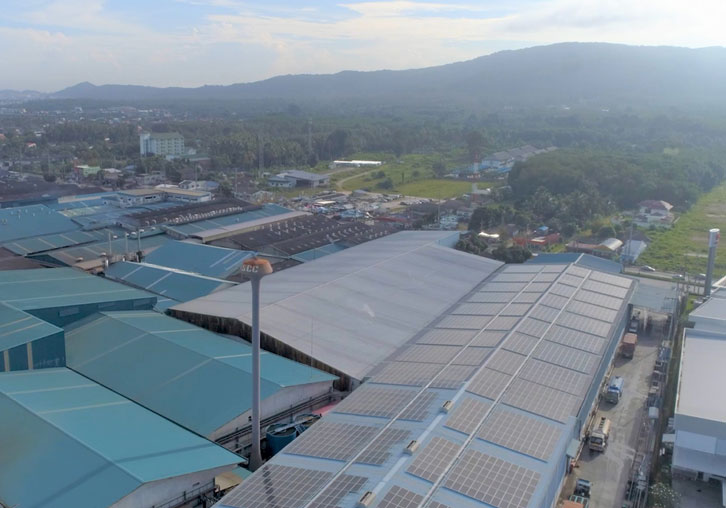
The Company is committed to sustainability and reducing environmental impact. A key part of this effort is the adoption of solar energy as a renewable energy source across its operations.
By leveraging solar power, the Company has significantly improved energy efficiency and reduced carbon emission, thus taking a major step towards a more sustainable future.
- Samut Sakhon Facility : Solar energy usage increased from the target of 3% to 20%, following the successful completion of Phase 1, which added 2.6 MW of solar capacity. This initiative has led to a reduction of 1,644 tons of CO2 equivalent (CO2eq) from 2023, with solar energy now accounting for 13% of the facility’s total energy consumption.
- Songkhla Facility : Solar energy usage also increased from the target of 3% to 9.6%. Phase 1 installed 0.99 MW of solar capacity, leading to a reduction of 585 tons of CO2eq from 2023. Currently, solar energy contributes 5% of the facility’s total energy consumption. Phase 2, scheduled for completion in 2025, will add an additional 1.2 MW of solar capacity.
Additional energy improvements include reducing air compressor pressure from 6.1 bar to 5.3 bar, which resulted in saving approximately 75,800 units of energy.
These initiatives demonstrate the Company’s ongoing commitment to integrating renewable energy sources, reducing greenhouse gas emissions, and advancing toward greener operations.
The goal for 2025 is to reduce energy costs in the unit of net weight baht per kilogram by 3% from 2024.
Toxic and Non-toxic management
Energy intensity reduction
Energy intensity reduction target (GJ/TFG)
Note : *reduction -10%
i-Tail has established a comprehensive energy management roadmap, targeting a 10% reduction in specific energy consumption by 2030 against a 2025 baseline. The Company aims to achieve a consistent annual reduction of 2%, lowering energy intensity from 7.89 GJ/T FG to 7.13 GJ/T FG over the next five years.
This roadmap is supported by strategic capital investments, including the biomass boiler project in 2025, which is designed to replace aging infrastructure and significantly reduce greenhouse gas emissions. By transitioning away from fossil fuel-based energy sources and enhancing operational efficiency, i-Tail is aligning its business growth with global sustainability standards and the transition toward a low-carbon economy.
Through this data-driven approach, i-Tail remains committed to strengthening environmental stewardship while creating long-term sustainable value for stakeholders.